
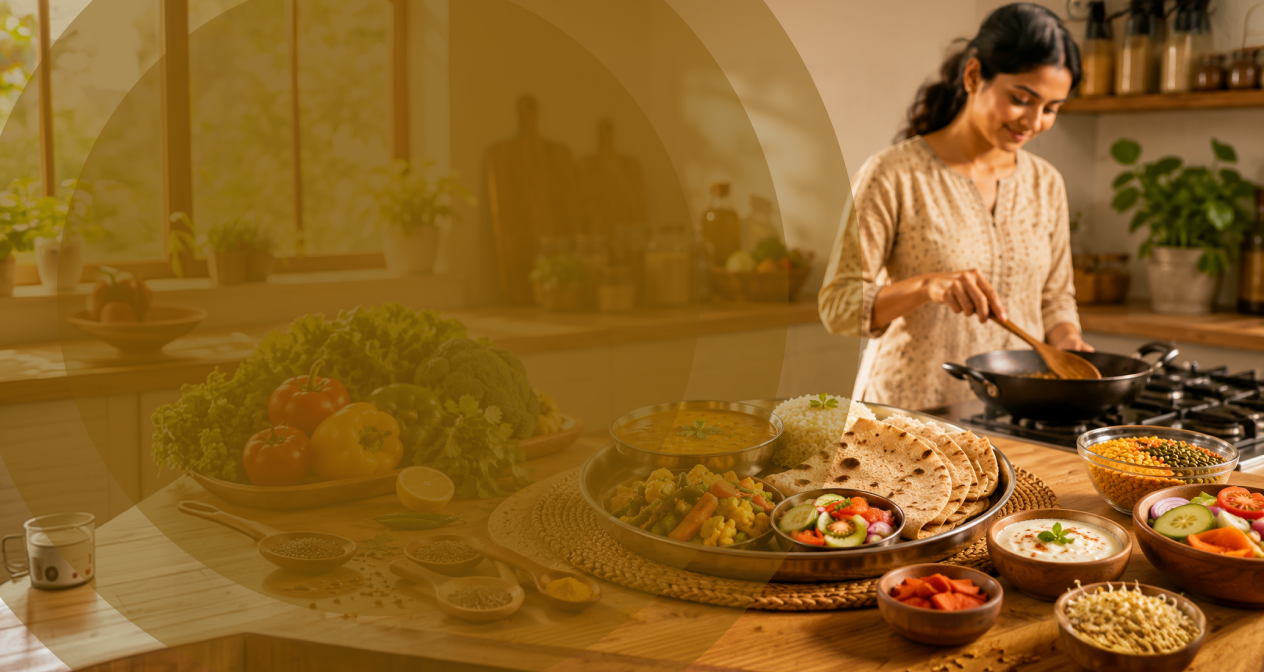
Tips for Making Everyday Indian Meals More Balanced
Summary
Looking for simple ways to eat better? Explore healthy eating tips, balanced meal ideas, and the best cooking oils to make everyday Indian meals more nutritious.
Good, healthy eating tips don't have to mean giving up the meals you grew up with. For most Indian households, the real opportunity lies in adjusting proportions and cooking habits rather than overhauling the menu. A simple dal-chawal-sabzi spread can become a genuinely balanced diet without losing what makes it comforting and familiar in the first place.
Small daily choices matter more than dramatic changes. What you put on your plate, how much oil you use, and how you cook it all add up over weeks and months. That's why these healthy eating tips focus on realistic habits rather than strict rules that rarely last.
Let's see how to rethink your plate ratios, build smarter meal combinations, and choose the right cooking oil, including options like King's Edible Oils, so that nutritious Indian food becomes your everyday norm rather than the exception.
Healthy Eating Tips for Choosing the Right Cooking Oil: King's Soybean Oil and More
Oil choice is one of the simplest healthy eating tips people overlook. Most of us pick an oil out of habit and never think about whether it suits the dish. Yet the oil you cook with shapes both the taste and the fat content of every meal.
A neutral, everyday oil works best for the bulk of your cooking. King's Soybean Oil is a good example. It has a mild flavour that doesn't overpower your spices, and it handles regular sautéing, curries, and even baking comfortably.
Here's a useful idea: swapping oils thoughtfully, rather than simply using less, can shift a meal toward a more balanced diet without changing the recipe at all. You keep the flavour your family loves and quietly improve the nutrition.
King's Mustard Oil and Traditional Cooking: A Healthy Eating Tip Worth Knowing
King's Mustard Oil has a strong, distinct flavour that plays a central role in regional Indian cooking, such as Bengali fish curries, Punjabi sarson recipes, and traditional pickles, where the pungency is part of the dish itself.
Using mustard oil for tempering, marinating, and pickling brings out flavours that a neutral oil simply cannot. This is a practical healthy-eating tip in itself: match the oil to the dish rather than defaulting to one oil for everything.
When you use the right oil for the right recipe, you support both flavour and variety in your kitchen. A little planning here makes ordinary meals taste far more authentic.
Rethinking the Indian Diet: Simple Healthy Eating Tips for Every Meal
A balanced Indian diet isn't complicated. On a typical thali, it comes down to getting the proportions right across four things: grains, protein, vegetables, and fat.
A helpful rule of thumb for the plate:
- Half the plate of vegetables and salad, such as sabzi, greens, cucumber, and tomato.
- One quarter of whole grains, such as roti, brown rice, and millets.
- One quarter protein, such as dal, rajma, chana, paneer, curd, and eggs.
- A small, measured amount of cooking oil.
Two easy healthy eating tips fit right into daily life: add a vegetable side to every meal and avoid repeating the same starch at both lunch and dinner. If lunch is rice, make dinner roti or millet. These tiny swaps keep your Indian diet varied and better balanced.
King's Rice Bran Oil: A Smart Swap for Everyday Cooking
King's Rice Bran Oil fits neatly into daily cooking, especially for dishes that benefit from a light, neutral oil used in moderate amounts. It has a mild taste and holds up well under the heat of regular Indian cooking.
The key point here is portioning, not eliminating. Fat is still an important part of a balanced diet; it helps your body absorb certain vitamins and keeps food satisfying.
The goal is to measure your oil rather than free-pour it. A simple habit is to use a spoon to add oil instead of pouring straight from the bottle. You'll often use far less than you think, and your meals stay just as tasty.
Building Nutritious Indian Food Around Balanced Meal Ideas
Nutritious Indian food usually comes down to combinations rather than special ingredients. Most of what you need is already in your kitchen.
Notice the pattern, where each plate has a grain, a protein, a vegetable, and something fresh. That's the whole idea behind healthy home cooking. It doesn't need more time or fancy ingredients, just a better pairing of the staples you already buy.
Some easy balanced meal ideas:
- Dal + brown rice + a vegetable sabzi + curd
- Rajma or chana + roti + cucumber salad
- Vegetable khichdi + curd + a side of stir-fried greens
- Besan chilla + mint chutney + a bowl of fruit
Small Changes, Big Impact: Healthy Eating Tips for a Healthier Indian Diet
The most reliable way to build a healthy Indian diet is through consistent small changes, not a strict diet you'll abandon in a week. None of these requires new recipes or extra effort.
Done regularly, they're what sustains a balanced diet and genuinely healthy home cooking over time.
Quick tips you can start today:
- Measure oil with a spoon instead of pouring freely.
- Steam, grill, or shallow-fry more often than deep-frying.
- Match the oil to the dish for better taste and variety.
- Add one extra vegetable to every meal.
- Keep portion sizes steady, especially for rice and roti.
- Include curd, salad, or fruit to round off the plate.
Balanced eating in an Indian kitchen isn't about giving up your favourite meals; it's about small, steady adjustments. Rework your plate ratios, add more vegetables, keep oil portions in check, and match the right oil to the right dish.
These healthy eating tips fit into everyday cooking without extra effort or unfamiliar ingredients.
The oil you cook with is an easy place to start. Whether it's King's Soybean Oil for daily sautéing, King's Rice Bran Oil for light everyday meals, or King's Mustard Oil for traditional recipes, choosing thoughtfully makes healthy home cooking simpler.
King's Edible Oils can be a reliable everyday companion as you build meals your whole family enjoys.
Frequently Asked Questions
What are the most effective healthy eating tips for everyday Indian meals?
The most effective tips are simple: fill half your plate with vegetables, keep protein and whole grains balanced, and measure your cooking oil instead of free-pouring.
Rotate oils for different dishes, avoid repeating the same starch across meals, and choose steaming or shallow frying over deep frying. Consistency with these small habits matters more than any single dramatic diet change.
How can I turn a regular Indian meal into a balanced diet without new ingredients?
You usually don't need anything new, just better proportions. Add a vegetable sabzi or salad, include a protein like dal or curd, and pick a whole grain such as roti or brown rice.
Keeping oil portions measured helps too. A standard dal-chawal-sabzi plate becomes a balanced diet simply by adjusting how much of each element you serve.
Is King's Cooking Oil suitable for daily tadka and sautéing?
Yes. Neutral options from the King's range, such as King's Soybean Oil and King's Rice Bran Oil, work well for everyday tadka, sautéing, and curries. Their mild flavour lets your spices take the lead rather than compete with them.
For flavour-forward dishes and pickles, King's Mustard Oil is the better match, so keep a couple of oils on hand for different cooking needs.
Which King's oil is best for everyday family cooking?
For general daily cooking, a neutral oil is easiest to work with. King's Soybean Oil and King's Rice Bran Oil both suit regular curries, sautéing, and shallow frying without altering the taste of your food.
King's Mustard Oil is best reserved for traditional recipes, pickles, and regional dishes where its strong flavour is meant to stand out.
Do I need to use less oil to eat healthier?
Not necessarily. Fat is part of a balanced diet. The goal is portioning rather than cutting it out completely.
Measuring oil with a spoon instead of pouring freely usually reduces how much you use naturally. Choosing the right oil for the dish and cooking method matters as much as the quantity, so focus on both together for the best results.




Frequently Asked Questions
The most effective tips are simple: fill half your plate with vegetables, keep protein and whole grains balanced, and measure your cooking oil instead of free-pouring. Rotate oils for different dishes, avoid repeating the same starch across meals, and choose steaming or shallow frying over deep frying. Consistency with these small habits matters more than any single dramatic diet change.
You usually don't need anything new, just better proportions. Add a vegetable sabzi or salad, include a protein like dal or curd, and pick a whole grain such as roti or brown rice. Keeping oil portions measured helps too. A standard dal-chawal-sabzi plate becomes a balanced diet simply by adjusting how much of each element you serve.
Yes. Neutral options from the King's range, such as King's Soybean Oil and King's Rice Bran Oil, work well for everyday tadka, sautéing, and curries. Their mild flavour lets your spices take the lead rather than compete with them. For flavour-forward dishes and pickles, King's Mustard Oil is the better match, so keep a couple of oils on hand for different cooking needs.
For general daily cooking, a neutral oil is easiest to work with. King's Soybean Oil and King's Rice Bran Oil both suit regular curries, sautéing, and shallow frying without altering the taste of your food. King's Mustard Oil is best reserved for traditional recipes, pickles, and regional dishes where its strong flavour is meant to stand out.
Not necessarily. Fat is part of a balanced diet. The goal is portioning rather than cutting it out completely. Measuring oil with a spoon instead of pouring freely usually reduces how much you use naturally. Choosing the right oil for the dish and cooking method matters as much as the quantity, so focus on both together for the best results.

